

El Niño 2026 forecast: 90% LPA rainfall, below-normal monsoon, Odisha, Chhattisgarh, MP, UP are most vulnerable; Gujarat, Telangana, Haryana, Rajasthan most resilient

CareEdge Ratings share the latest report on El Niño 2026 – Is India Ready?
The IMD has forecast rainfall over India at 90% of the Long Period Average (LPA), indicating a below-normal monsoon in the country. The probability distribution of rainfall is heavily skewed towards deficient rainfall, with a higher likelihood of El Niño conditions during the monsoon. The impact of a poor monsoon will be felt in agriculture and rural demand, as lower rainfall constrains crop output and weighs on farm incomes. This could, in turn, translate into broader price pressures through elevated food inflation. However, India seems better placed to handle this situation than in some past El Niño episodes. Reservoir levels as of end-April are better compared to past El Niño years, and robust foodgrain buffer stocks should help somewhat cushion inflationary risks. In parallel, the government’s proactive contingency planning provides an additional layer of support to mitigate potential disruptions. Moreover, over the last decade or so, the adverse impact of the monsoon on the agricultural sector and the overall economy has relatively reduced. While the aggregate impact of El Niño is likely to remain manageable, the possibility of localised disruptions cannot be ruled out. We have created a State-wise Poor Monsoon Resilience index (SPMRI) based on several parameters that indicate uneven vulnerability to poor monsoon across states.
Forecast of Below Normal Rainfall and El Niño Conditions
The India Meteorological Department (IMD), in its updated Long-Range Forecast for the South-West monsoon, stated that rainfall over the country in June – September is projected to be 90% of the long-period average (LPA)[1], down from 92% projected earlier, indicating a below-normal monsoon2 over most parts of the country. While some areas in Northwest and Northeast India, as well as other regions, are expected to receive normal or above-normal rainfall, the monsoon core zone (MCZ), which includes most of the country’s rainfed agricultural areas, is most likely to receive below-normal rainfall. The probability distribution of rainfall is skewed towards deficient rainfall, with an 84% likelihood of sub-normal conditions, higher than 66% projected in April 2026 (Exhibit 1).
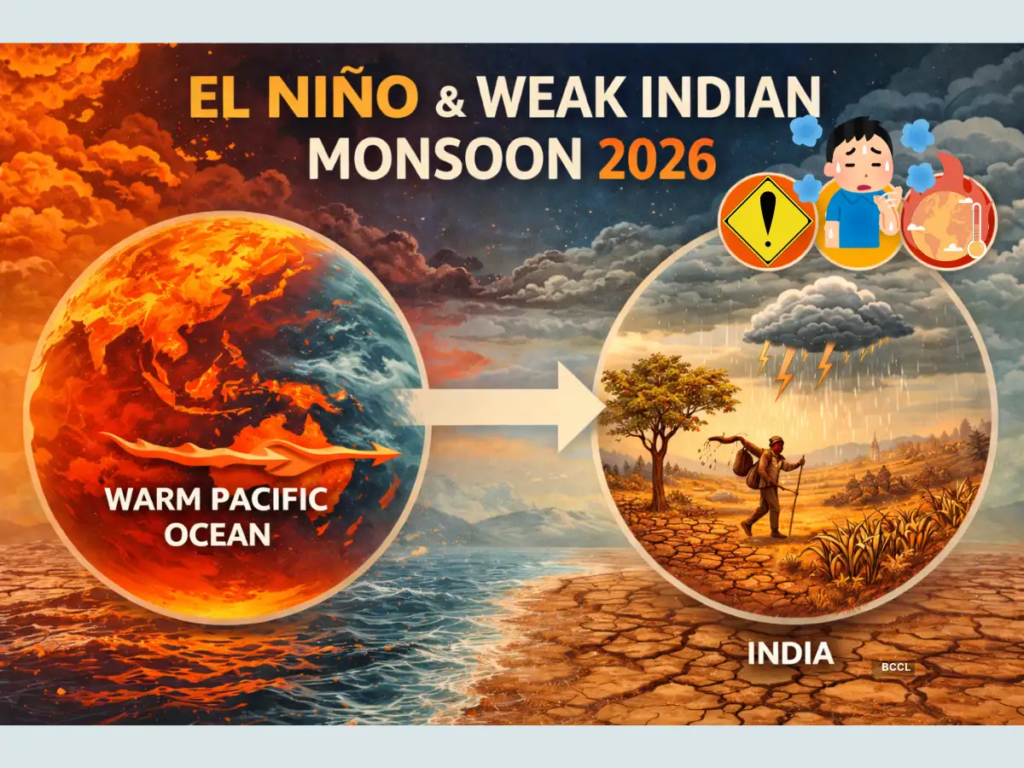
The IMD notes that sea surface temperatures indicate the formation of El Niño conditions during the monsoon season, while the Indian Ocean Dipole remains neutral. As per the National Oceanic and Atmospheric Administration (NOAA), there is a significant chance of at least a moderate-strength El Niño developing over June – September
Exhibit 2: Likelihood of El Niño Over the Coming Exhibit 3: Likelihood of the Strengths of El Niño Year Through the Coming Year
(ii) The classification of the strength of El Niño is done based on the Relative Oceanic Niño Index (RONI), measured in °C. The classification is done as follows: (a) Neutral: -0.5°C< index <0.5°C; (b) Weak El Niño: 0.5°C ≤ index < 1.0°C; (c) Moderate El Niño: 1.0°C ≤ index < 1.5°C; (d) Strong El Niño: 1.5°C ≤ index < 2.0°C; (e) Very Strong El Niño: index ≥ 2.0°C
Analysing the Impact of El Niño Based on Past Patterns
Since 1951-52, there have been 25 El Niño episodes. As Exhibit 4 demonstrates, not all El Niño occurrences necessarily imply lower rainfall. However, most El Niño episodes coincide with below the long-period average rainfall. If the strength of the El Niño is moderate or higher, the probability of lower rainfall increases – in the 16 instances of “moderate” or stronger episodes of El Niño, 12 years witnessed either below-normal or deficient rainfall (Exhibit 4). This becomes important given the increasing chances of a “moderate” or strong El Niño developing from the beginning of the first three months of this year’s monsoon.
Rainfall and Output: An Important but Weakening Linkage
Since 1951-52, there have been 23 years in which agricultural GVA declined in the country. 57% or (13 of these contractions) occurred during El Niño years. Overall GVA growth was also lower in El Niño years than in Non-El Niño years (Table 1). However, there is evidence that the linkage between the growth rates of overall GVA and agricultural GVA, and rainfall variability has weakened over time. Exhibits 5 and 6 plot the time-varying coefficients capturing the sensitivity of agricultural and overall GVA growth to rainfall deviations. These are estimated using 20-year rolling regressions, with each coefficient reflecting the relationship over the previous 20-year window. The coefficient can be interpreted as the marginal effect of rainfall deviations on agricultural GVA growth and overall GVA growth, respectively. These effects have declined over time.
| Table 1: Average Annual GDP Growth and Agri Production During El Niño and Non-El Niño Years | ||||
| 1951-52 to 2024-25 | No. of years | Rainfall Deviation from LPA | Average Agriculture GVA growth | Average Overall GVA growth |
| Weak El Niño Years | 9 | -4.6 | 1.1 | 4.3 |
| Moderate El Niño Years | 9 | -5.5 | 1.0 | 5.2 |
| Strong El Niño Years | 4 | -13.2 | -5.6 | -0.9 |
| Very Strong El Niño Years | 3 | -7.0 | -0.7 | 5.1 |
| Total El Niño Years | 25 | -7.6 | -1.1 | 3.4 |
| Non-El Niño Years | 49 | 1.5 | 4.7 | 5.6 |
Note – Marginal impact of rainfall deviation is measured by the coefficient estimated using 20-year rolling regressions of rainfall deviation on GVA and agriculture GVA, respectively.
These developments may be attributed to a range of factors, foremost among them being the substantial structural transformation of the economy. The share of agriculture in GVA has declined markedly from 53.2% in FY1951 to 16.8% in FY2026, while the share of the tertiary sector has expanded from 35.5% to 54.9% over the same period (Exhibit 7). Consequently, rainfall-induced shocks now directly affect a relatively smaller segment of the economy, although their effects continue to be transmitted indirectly through channels such as inflation, employment and consumption. Another reason for the lower sensitivity towards rainfall is the rise in irrigated area. Gross area under irrigation as a percentage of gross sown area has gone up significantly from 17.1% in FY1951 to 60% in FY2024 (Exhibit 8). Therefore, the share of solely rainfed areas has declined markedly. Finally, the government’s efforts to promote sustainable farming and crops that require less water, such as millets and pulses, may also be playing a role in reducing the dependence of output growth on rainfall. Under the National Agricultural Research System led by ICAR, 2,996 climate-resilient crop varieties were released during 2014-2025. It is important to note that although the agriculture sector’s share of GVA has declined, it remains the largest source of employment in the country. According to the PLFS 2025, the agriculture sector accounted for 43% of total employment in 2025 (down from 46% in 2022). Hence, disruptions in the sector continue to have significant implications for a large share of the workforce.
While crop production remains the main source of agricultural income, there has been some diversification within the sector. National Accounts Statistics data on household incomes[2] in the agriculture sector indicate that the share of income derived from crop production declined from 63% in FY2012 to 53% in FY2024. In contrast, the contribution of livestock increased from 24% to 33%, while the share of fishing and aquaculture rose from 4.4% to 7.5% over the same period. Although this diversification provides some resilience, crop-related activities continue to account for a substantial share of income, leaving rural incomes vulnerable to some disruption induced by poor rainfall. However, as discussed earlier, the adverse impact of the monsoon on the agricultural sector and the overall economy has diminished over the last decade or so.
Rainfall and Inflation
Apart from its impact on output, deficient rainfall also affects the economy through the food inflation channel. Historical data presents mixed evidence. While some episodes of deficient rainfall (rainfall below 90% of the Long Period Average (LPA)) and the following years have coincided with higher WPI food inflation, deficient rainfall does not necessarily lead to price pressures (Exhibit 9). For instance, despite a very strong El Niño leading to deficient rainfall in 2015-16, food prices remained relatively subdued. Factors such as good buffer stocks, supply-side interventions and stable global commodity prices capped price pressures in the food basket.
El Niño conditions are typically associated with heatwaves and abnormal weather patterns, which can intensify inflationary pressures in perishable food items such as fruits and vegetables. In particular, tomatoes, onions and potatoes—commodities that have historically contributed to seasonal spikes in retail food and headline inflation— may face additional price pressures during such episodes. Vulnerability also extends to pulses, where both acreage and yields have historically been adversely affected during El Niño years. A NITI Aayog report[3] notes that 15 El Niño episodes since 1951 have been associated with declines in pulse acreage and productivity, underscoring the sensitivity of the crop to weather-related disruptions.
Another important channel to monitor is imported food inflation, particularly for commodities sourced from countries similarly affected by El Niño conditions. For instance, India relies heavily on Malaysia and Indonesia for palm oil imports, both of which are vulnerable to El Niño-induced weather disruptions. Consequently, adverse weather conditions in these countries could exert upward pressure on domestic palm oil prices.
India’s Preparedness for the Upcoming El Niño
India is better positioned this year than during previous El Niño episodes. As of May 2026, live storage in reservoirs stands at 30.4% of live storage at full reservoir level (FRL), higher than the average of 25.1% observed during El Niño years between 2015–16 and 2023–24 (Exhibit 10). This relatively stronger reservoir position enhances resilience by providing a larger buffer of assured water supply for irrigation, thereby reducing the immediate dependence of agricultural output on contemporaneous rainfall shocks. In addition, buffer stocks of wheat and rice are at record levels as of end-April 2026 (Exhibit 11). Consequently, even if below-normal rainfall weighs on the production of key crops, adequate stocks are likely to somewhat mitigate supply disruptions and help contain inflationary pressures.
State-wise Poor Monsoon Resilience Index (SPMRI)
While reservoir levels and buffer stocks of wheat and rice provide supportive conditions at the aggregate level, assessing vulnerability at the state level offers a more granular view of how an El Niño event could impact key regions. To this end, we have constructed an index that presents a near-term vulnerability snapshot of states. We use six parameters: reservoir levels, the share of agricultural GVA in overall GVA, the share of non-crop GVA in agricultural GVA, irrigation coverage, the share of water-intensive crops in kharif output, and the average deviation of rainfall from LPA over the last 50 years. States were compared across these parameters and assigned a score between 0 and 100 using the Min-Max normalisation technique. We then constructed a composite weighted index from these normalised scores. A high score indicates greater resilience, and a low score indicates lower resilience.
The methodology is detailed towards the end of the report.
We recognise that more factors such as state and district specific policy actions, could affect the resilience of states, but could not be incorporated due to data limitations. For instance, the Maharashtra government has issued coordinated preparedness directives focusing on water conservation and storage, drought planning and fodder security, and restoration of water bodies. ICRISAT[4] and partners released a new anticipatory action and response plan recommending climate-resilient crops, water-saving practices and district-level contingency measures to reduce climate-related risks6. The Central government, too, has identified 197 vulnerable districts while also preparing state-wise contingency plans.
Note: A lower score implies the state is relatively more vulnerable; a higher score implies the state is relatively more resilient
Uneven Resilience Across States
Odisha, Chhattisgarh, Madhya Pradesh, and Uttar Pradesh emerge as relatively more vulnerable to the forthcoming El Niño episode. Odisha and Chhattisgarh are characterised by significantly lower irrigation coverage relative to the other states under consideration. Gross irrigated area as a percentage of gross sown area in Odisha and Chhattisgarh is 30.5% and 32.2%, respectively, compared to the national average of 60%. This is compounded by a relatively higher share of water-intensive crops in the kharif output of these states (92.6% in Odisha and 96.2% in Chhattisgarh), thereby increasing their susceptibility to deficient rainfall. In Madhya Pradesh, the agricultural sector displays relatively limited diversification towards allied activities, thereby increasing dependence on crop output. Uttar Pradesh, while having good irrigation coverage, has a kharif crop composition that is very heavily skewed towards water-intensive crops (98.4%) compared to other states, while also having a relatively low share of non-crop GSVA activities in agricultural GSVA (34.6% as compared to the average of 45.7% across states).
In contrast, the major states of Gujarat, Telangana, Haryana and Rajasthan appear relatively better placed to withstand potential weather-related disruptions. At 16.8%, Gujarat’s share of agricultural GSVA in overall GSVA is lower than the average across states (19.3%), implying that a relatively smaller segment of the economy is directly exposed to the risk of deficient rainfall. The state falls within the West zone, which currently has relatively stronger reservoir positions than other regions. In addition, over the past five decades, the state has, on average, received rainfall above its long-period average. These factors together contribute to Gujarat’s resilience. Haryana’s strong irrigation infrastructure and greater diversification within the primary sector GSVA towards livestock may help mitigate vulnerability arising from its crop mix. Haryana is a leading producer of milk and dairy products, which has led its livestock GSVA to account for 46% of agricultural GSVA. Telangana also benefits from a similar diversification. The state is a leading producer of eggs and meat, leading to livestock GSVA comprising 45.9% of its agricultural GSVA. Additionally, the state’s relatively lower share of agriculture in overall GSVA will limit the likely impact of an El Niño-induced shortfall of rain.
Rajasthan stands out for having the lowest share of water-intensive kharif crops among the states considered, at around 8%. The state is the country’s largest producer of wool and the second-largest producer of milk, thereby leading to a significant share of non-crop GSVA (46.8%) within agricultural GSVA. This, combined with its low share of agricultural GSVA relative to overall GSVA, makes it the most resilient state to a poor monsoon. Interestingly, despite having 100% irrigation coverage and comfortable reservoir levels, Punjab does not rank among the five most resilient states. This is primarily attributable to the state’s high dependence on water-intensive crops in kharif output (98%), particularly rice, which somewhat offsets the advantages arising from its irrigation and reservoir position.
Conclusion and Outlook
Overall, while the forecast of below-normal rainfall and the likely emergence of El Niño pose clear risks to agriculture, rural demand, and food inflation, India appears better prepared than in past episodes. Structural shifts in the economy, such as higher irrigation coverage, an increasing share of the non-agriculture sector, and gradual diversification within the agriculture sector to livestock, fisheries, etc., have reduced the direct macroeconomic sensitivity to rainfall shocks. Additionally, this year India benefits from higher reservoir levels and strong buffer stocks of wheat and rice, which add resilience. However, overall vulnerability remains uneven across states, with some states being more vulnerable due to weaker irrigation and crop patterns. Going forward, close monitoring of monsoon progress, inflation trends, and regional stress points will be crucial. On balance, the impact of El Niño may be manageable at the aggregate level, though localised disruptions cannot be ruled out.
| State-wise Poor Monsoon Resilience Index (SPMRI) – Methodology We use six parameters: (i) irrigation coverage; (ii) the share of primary sector Gross State Value Added (GSVA) in total GSVA (at current prices); (iii) the share of non-crop GSVA within the agricultural GSVA (at current prices); (iv) the share of water-intensive crops (rice and sugarcane) in total kharif crop output; (v) state-wise average rainfall deviation from long-period average (LPA) over the last 50 years; and (vi) regional reservoir levels. Based on the data for parameters (i) – (v), each state was assigned a score on a scale of 0-100 for each parameter using the Min-Max normalisation technique, such that a score of 0 denotes low resilience and 100 denotes high resilience. For parameter (vi), relating to regional reservoir levels, states were grouped into five zones—North, South, East, West, and Central—reflecting the shared nature of reservoir networks. Reservoir storage levels as of 29 May 2026 were aggregated at the zonal level, following which the percentage deviation from normal levels was computed. Subsequently, scores were derived using the Min-Max normalisation method, and the corresponding zonal scores were assigned to states within each region. The scores across parameters were then combined using a weighted approach to generate a composite index ranging from 0 to 100. The weights are as follows: S.No. Parameter Name Weight 1 Region-wise reservoir levels 10% 2 State Irrigation Coverage 20% 3 Share of agricultural GSVA in overall GSVA 20% 4 Share of allied activities in agricultural GSVA 20% 5 Share of water-intensive crops in the total volume of Kharif output 20% 6 Average deviation of rainfall from LPA over the last 50 years 10% |
[1] The long period average (LPA) refers to average rainfall over the previous 50 years.
[2] Compensation of Employees (CE) and Operating Surplus/Mixed Income (OS/MI) in the agriculture industry are used as a proxy for rural income as the sector is predominantly characterised by household-based and selfemployed production activities. In this context, CE largely reflects wages paid to hired agricultural labour, while OS/MI captures the residual income accruing to cultivator households, including returns to family labour, land, capital and entrepreneurial activity.
[3] https://niti.gov.in/sites/default/files/2025-09/Strategies-and-Pathways-for-Accelerating-Growth-in-Pulsestowards-the-Goal-of-Atmanirbharta.pdf
[4] ICRISAT or the International Crops Research Institute for the Semi-Arid Tropics is an international intergovernmental institution specialising in research and development of climate resilient farming systems. 6 https://pressroom.icrisat.org/maharashtra-moves-early-to-tackle-threat-of-el-Niño-driven-monsoon-disruptions
Source: CareEdge analysis based on data from IMD, Dept of Agriculture and Farmers Welfare, CWC and MoSPI;
(Disclaimer: The information provided here is investment advice only. Investing in the markets is subject to risks and please consult your advisor before investing.)
(સ્પષ્ટતા: અત્રેથી આપવામાં આવતી તમામ પ્રકારની માહિતી કોઇપણ પ્રકારે રોકાણ/ ટ્રેડીંગ માટેની સલાહ નથી. બજારોમાં રોકાણ જોખમોને આધીન છે અને રોકાણ કરતા પહેલા કૃપા કરીને તમારા સલાહકારની સલાહ લો. વધુમાં અત્રે પ્રગટ થયેલા કોઇપણ સમાચાર કે વિગતો સાથે businessgujarat.in અંશતઃ કે સંપુર્સણપણે સહમત નથી.)