
India Inc Stands Tall – Can Resilience Outlast Global Uncertainty?
MUMBAI, September 30th: India Inc continued to demonstrate resilience in the first half of this fiscal year (H1FY27), with credit quality strengthening despite a persistently uncertain global environment marked by geopolitical tensions, volatile energy prices, inflationary pressures and renewed monetary tightening.
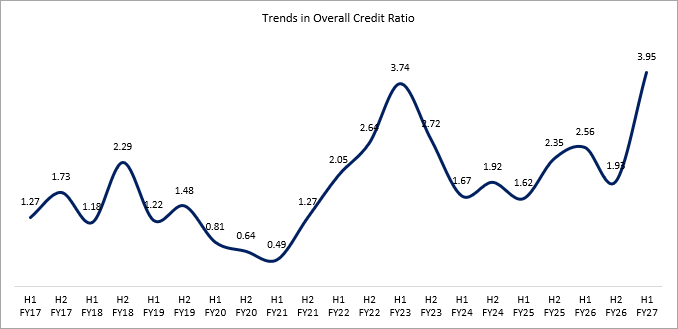
CareEdge Ratings’ credit ratio, or the proportion of rating upgrades to downgrades, nearly doubled to 3.95 times in H1FY27 from 1.93 times in the second half of the previous fiscal year (H2FY26). This improvement reflected not only stronger upgrade momentum but also a meaningful decline in downgrades. Overall, there were 300 rating upgrades against 76 downgrades during the period.
The upgrade rate rose to 16% in H1FY27 from 13% in H2FY26, remaining above the 10-year average of 15%. More strikingly, the downgrade rate fell to just 4% from 7%, reaching an all-time low. Overall, with the reaffirmations at around 80% of the ratings reviewed during the past few years, these trends point to broad-based stability and a notably stronger credit environment across the rated portfolio.
Also, corporate India today is fundamentally better positioned than it was a decade ago, underscoring the rating trends. Between 2016 and 2026, overall gearing[1] nearly halved from 1.04 times to 0.50 times, while PBILDT[2] margins expanded from 10% to 14%, and interest coverage sustainably increased from 4.10 times to 7.59 times. Healthier balance sheets and stronger profitability have improved India Inc’s ability to absorb external shocks and navigate periods of uncertainty.
Sachin Gupta, Executive Director and Chief Rating Officer, CareEdge Ratings, commented on the evolving economic landscape, stating, “The improvement in credit quality comes at a time when the external environment has become considerably more challenging. Geopolitical tensions have kept global energy prices high, contributing to inflationary pressures across major economies. Global monetary conditions have also tightened, with the US Federal Reserve raising its benchmark rate in September and several other major central banks resuming policy tightening. The domestic economy, meanwhile, delivered a stronger-than-expected performance despite global headwinds. Buoyant consumption, a pickup in investment, a healthy external position and India Inc’s leaner balance sheets give us confidence in the resilience of the Indian economy looking ahead in fiscal 2027.”
The sectoral picture reinforces this broader resilience. The credit ratio for the manufacturing and services sector improved to 2.84 times in H1FY27, up from 2.06 times in H2FY26. Ranjan Sharma, Senior Director, CareEdge Ratings (Corporate Ratings), noted, “Upgrades were driven by resilient domestic demand across consumer-linked sectors such as auto ancillaries & dealerships, textiles and gold jewellery retailers, as well as infrastructure-led demand supporting the iron & steel and capital goods sectors, while robust leasing demand benefitted the real estate sector. Downgrades were concentrated largely among smaller entities with presence in limited value-added segments such as commodity trading and distribution, agricultural food & other products and road transport services. Going forward, the outlook for the manufacturing & services sector in H2FY27 remains stable, supported by resilient domestic demand, anticipated diversification benefits from various bilateral FTAs struck recently, and India Inc’s deleveraged balance sheets. However, inflationary pressures in the economy arising from higher energy costs and abating benefits from last year’s GST rate cuts could affect margins and growth to an extent. Evolving geopolitical uncertainties around the West Asia conflict and potential US tariffs warrant a cautious outlook on exports.”
The infrastructure sector recorded the sharpest improvement among the major sectors, with its credit ratio increasing to 8.31 times in H1FY27 from 1.67 times in H2FY26. Part of this increase, however, was driven by a large portfolio-level rating action, wherein a change in the credit profile of a single large group resulted in upgrades across multiple linked entities. Even after adjusting for this action, the infrastructure credit ratio remained strong at around 5 times. Rajashree Murkute, Senior Director, CareEdge Ratings (Infrastructure Ratings), highlighted, “Project commissioning continued to support upgrades, particularly across Hybrid Annuity Model (HAM) road projects and renewable power. Timely payments from most state distribution utilities also supported faster-than-anticipated deleveraging for power producers and transmission infrastructure providers. On the other hand, downgrades were primarily driven by deterioration in capital structures of certain renewable energy sponsor holding companies amid rising non-project debt and operational underperformance, alongside execution delays, weak order-books, and heightened working capital pressures faced by select mid-sized Construction sector players. Looking ahead, the sector outlook remains stable. While commissioning activity, particularly in road projects, is expected to remain supportive in the near term, the moderation in project awards over the past year may temper the pace of future commissioning-driven upgrades. Nevertheless, robust power demand and healthy infrastructure-led order books are expected to support overall sector credit quality in the near term.”
Banking, Financial Services, and Insurance (BFSI) sector also recorded a material improvement, with its credit ratio rising to 5.40 times from 2.25 times in H2FY26. This was mainly due to higher upgrades and fewer downgrades. Vineet Jain, Senior Director, CareEdge Ratings (BFSI Ratings), said, “Asset quality and funding have remained stable across banks, NBFCs and HFCs. M&A, equity infusions, and improvements in scale, profitability, and asset quality drove upgrades. Secured segments such as mortgages, gold loans, loan against property and vehicle finance remain healthy. Banks are well capitalised, and net NPAs are historically low. However, pockets of stress persist. Downgrades were concentrated in smaller, MFI-heavy NBFCs facing elevated credit costs and funding pressures. Close monitoring is warranted even as the broader sector continues to benefit from promoter and parent support”
Overall, India Inc’s credit performance in H1FY27 was encouraging not only because upgrades increased, but also because downgrade incidence declined significantly. However, the second half of fiscal 2027 is likely to test this resilience more meaningfully. The trajectory of geopolitical tensions, energy prices, inflation, global interest rates and trade policy will determine the extent to which external pressures transmit into corporate earnings, cash flows and credit quality. For now, India Inc stands on a significantly stronger footing — backed by healthier balance sheets, resilient domestic demand and improving credit metrics. Whether that resilience can outlast a prolonged period of global uncertainty will be the defining credit question for the remainder of fiscal 2027.
[1] Overall gearing= Total debt/Equity. It is based on an aggregated analysis of around 8,000 entities over the past decade, with financials sourced from the Ace Equity platform.
[2] PBILDT= Profit Before Interest, Lease, Depreciation, and Tax