

Low R&D spend at ~0.6-0.7% of GDP Hampers India’s Manufacturing Growth: CareEdge Ratings

Mumbai, 20th May 2026: According to CareEdge Ratings, India should target to increase its R&D spend to ~2% by 2035 in-line with its Asian peers, to enhance the share of manufacturing in GDP, which will require, greater private-sector participation, stronger innovation ecosystems and improved research-to-commercialisation pipelines.
India’s manufacturing sector output expanded at a compounded annual growth rate (CAGR) of ~5% over last nine years ended CY24, up from ~US$328 billion in 2015 to ~US$493 billion in 2024; however, its share in the gross domestic product (GDP) declined from ~16% in 2015 to ~13% in 2024, indicating structural challenges in scaling value-added production. Compared to Asian peers such as China, Japan, South Korea, and Vietnam, India’s manufacturing growth remains constrained by lower R&D intensity, limited technology absorption, and weaker innovation ecosystems.
“India’s manufacturing sector is at a critical inflection point. While recent policy initiatives strengthened production capabilities, long-term competitiveness will depend on the ability to transition to innovation-driven manufacturing, leading to greater value-addition. With R&D spending currently at ~0.6–0.7% of GDP, India remains significantly behind global peers”, says Ranjan Sharma, Senior Director, CareEdge Ratings.
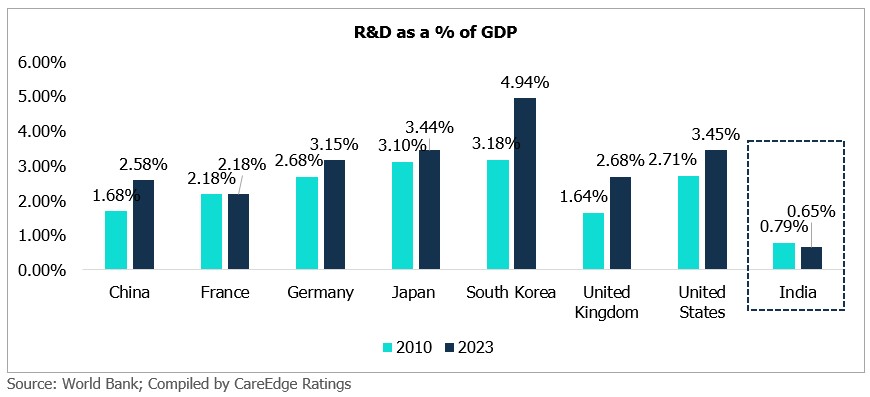
CareEdge Ratings notes that India’s R&D expenditure remains low at ~0.6–0.7% of GDP, significantly below global innovation leaders such as the United States (~3–3.5%), China (~2.5%), and South Korea (~4.0-5.0%). Low researcher density and weak industry–academia collaboration resulted in limited patent output (~4% global share), reflecting inefficiencies in innovation conversion.
R&D spending among listed Indian companies is concentrated in a few sectors, primarily automobiles, pharmaceuticals, chemicals, and metals, while the broader industrial base remains under-invested. Innovation that emerges from this spending tends to be incremental rather than path-breaking, with Indian firms generally following global developments instead of leading them. As a result, the country has yet to secure a meaningful first-mover advantage in novel discoveries. For example, top innovator pharma companies on an average spend ~20% of its revenue on R&D, which remained at ~6% for top Indian pharma companies. Structural constraints including low private-sector participation in R&D, risk aversion, talent outflow, and scale-first growth strategies have hindered the transition towards innovation-led manufacturing.
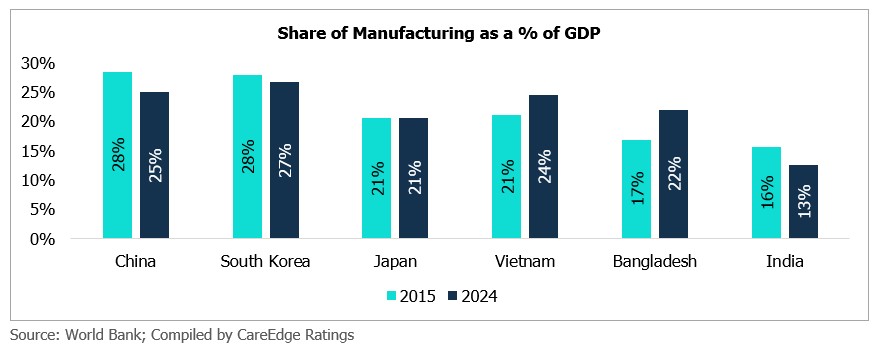
Manufacturing has historically been the backbone of rapid economic transformation across developing economies. Despite being one of the world’s fastest-growing major economies, India continues to lag its Asian peers in manufacturing-driven industrial expansion. In contrast, China and South Korea have sustained manufacturing share of ~25–27% of their respective GDPs while Vietnam and Bangladesh have expanded manufacturing intensity as a percentage of their GDP in this period through export-led strategies. In case of Vietnam and Bangladesh, this expansion has been driven primarily by low-cost labour, scale efficiencies and preferential foreign trade agreements (FTAs) that enhance export competitiveness, rather than by innovation-led capabilities.
“India’s manufacturing growth has been largely volume driven so far; but sustaining global competitiveness will require a decisive shift towards innovation and R&D led industrialisation. Strengthening private-sector participation and improving research commercialisation will be critical to unlocking higher value addition”, says Krunal Modi, Director, CareEdge Ratings.
Way Forward: Transitioning to Innovation-Led Manufacturing
CareEdge Ratings highlights that improving India’s manufacturing share requires significant investment in education especially science, technology, engineering and mathematics (STEM) and stronger integration between academic institutions and industry. While India’s education spending as a share of GDP (~4-4.6%) is broadly comparable to many countries, its per capita expenditure remains alarmingly low (~₹6,000), resulting in limited learning outcomes and skill development, particularly in technical and vocational training. It highlights that India needs to expand industry-aligned and technology-focused courses in engineering and applied sciences while ensuring curricula aligned with long-term national priorities such as self-reliance in manufacturing, critical technologies, and strategic sectors such as defence, energy, AI, semi-conductors, pharmaceuticals among others.
CareEdge Ratings calls for India to develop globally competitive industrial and innovation ecosystems which includes building high-quality industrial clusters, globally competitive compensation with modern infrastructure, improving ease of doing business, and ensuring regulatory accountability. Expanding tax incentives for R&D, improving access to risk capital, introducing performance linked funding models, and encouraging large business groups to invest in innovation and subsequently commercialise the same is critical for strengthening technological capability.
It notes that to sustain manufacturing competitiveness requires India to move beyond isolated industrial projects and develop fully integrated ecosystems that bring together suppliers/ customers, skilled labour, infrastructure, and R&D capabilities within the same clusters. For India, this implies creation of sector-specific hubs, such as semiconductor manufacturing corridors, biotechnology clusters, and advanced engineering zones designed to support end-to-end production and innovation within a single ecosystem.
(Disclaimer: The information provided here is investment advice only. Investing in the markets is subject to risks and please consult your advisor before investing.)
(સ્પષ્ટતા: અત્રેથી આપવામાં આવતી તમામ પ્રકારની માહિતી કોઇપણ પ્રકારે રોકાણ/ ટ્રેડીંગ માટેની સલાહ નથી. બજારોમાં રોકાણ જોખમોને આધીન છે અને રોકાણ કરતા પહેલા કૃપા કરીને તમારા સલાહકારની સલાહ લો. વધુમાં અત્રે પ્રગટ થયેલા કોઇપણ સમાચાર કે વિગતો સાથે businessgujarat.in અંશતઃ કે સંપુર્સણપણે સહમત નથી.)
